


Chamonix Mont-Blanc — Sports d'Hiver
Vintage-Style Art Deco Ski Poster (Single Skier)
LongSkisTruck™ Museum Poster Collection
Context
This poster is part of the LongSkisTruck Museum Poster Collection—a curated series of original, vintage-style ski posters created for skiers, collectors, and alpine historians. Unlike decorative ski prints, each poster in this collection is built on primary historical research, period-correct design language, and museum-grade reproduction standards. The focus on Chamonix highlights its transformation from a mountaineering hub to an Olympic venue, capturing the essence of Sports d'Hiver through a lens of Art Deco modernism and alpine authenticity.
These are not reproductions of existing posters, but original works inspired by the visual culture of early European ski tourism. Research, writing, and curation by LongSkisTruck™ Creative Studio.
As part of our curated series, each poster in the collection is paired with in-depth documentation to educate collectors on the provenance and significance of the depicted locations and eras. This ensures that the artwork serves not just as decoration but as a gateway to understanding ski history's evolution from utility to global sport.
TL;DR — For Collectors
- What This Is: Original Art Deco–inspired Chamonix ski travel poster (single skier).
- Era / Feel: Interwar French alpine modernism (1920s-1930s).
- Why It Works: Period-correct design paired with real alpine history.
- Best For: Ski historians, alpine travelers, and serious collectors.
- Finish Notes: Museum-quality giclée on archival matte; designed for framing.
Specifications
- Format / Size: Fine art poster print (museum-style wall art; designed for framing). Available in 18×24" and 24×36" sizes.
- Print / Paper: Museum-quality giclée using archival pigment inks on premium archival matte paper (189 gsm, acid-free, lignin-free). Rated for 100+ years without fading or yellowing. Matte finish for low glare.
- Source / Restoration: Original LongSkisTruck design (not a reproduction), built from period-correct design language and historical research.
- Sustainability Notes: Printed on demand to reduce waste and ensure consistency. Paper sourced from sustainably managed forests.
- Shipping / Handling: Ships free within the US. Printed on demand; typically ships within 3–5 business days. Shipped in a protective rigid mailer to prevent bending or creasing.
The History of Chamonix: From Mountaineering Cradle to Olympic Legacy
1) ORIGINS — THE VALLEY BEFORE SKIING
Chamonix's significance did not begin with skiing. Long before the first planks arrived, the valley was already central to European understanding of high mountains. The Mont Blanc massif—visible from Geneva, Lyon, and beyond—drew scientists, artists, and adventurers as early as the eighteenth century. The first recorded ascent of Mont Blanc in 1786 established Chamonix as the birthplace of alpinism, a distinction that shaped everything that followed.
By the eighteenth and nineteenth centuries, Chamonix had become synonymous with mountaineering itself. Guides, huts, mapped routes, and a growing body of alpine knowledge turned the valley into a laboratory for understanding steep terrain, snow, ice, and weather. This was not leisure culture in the modern sense; it was experiential knowledge gained through necessity. When winter arrived, movement through the valley demanded tools and techniques that would later intersect naturally with skiing.
Crucially, Chamonix developed a reputation beyond France early. British alpinists, continental explorers, and scientific travelers all treated the valley as a proving ground. That international awareness mattered. When winter sport later sought legitimacy, Chamonix did not need to invent a narrative. It already possessed one, grounded in geography and accumulated experience.
Access accelerated this process. The arrival of rail service from Saint-Gervais in 1901 transformed Chamonix from a remote alpine valley into a reachable destination without diminishing its seriousness. This combination—extreme terrain paired with reliable access—would become one of Chamonix's defining advantages. Skiing did not create Chamonix's importance; it inherited it.
2) EARLY ERA — SKIING MEETS THE REAL ALPS
At the turn of the twentieth century, skiing across Europe was in transition. In Scandinavia, it retained roots in transport and endurance; in the Alps, it was increasingly about descent. Steeper slopes, variable snow, and confined valleys forced technique to evolve. Chamonix sat at the center of this shift. Its terrain rejected casual experimentation and rewarded precision, balance, and control.
Early alpine skiing in Chamonix was shaped as much by necessity as by curiosity. Movement on snow was required to access huts, traverse glaciers, and descend safely from altitude. These demands pushed skiing toward technical seriousness earlier than in many other regions. Skiing here was not recreational by default; it had to work.
As winter visitors increased, skiing began to merge with leisure, but Chamonix never became gentle. Unlike purpose-built resorts that would follow later, the valley retained its alpine character. Slopes were not manicured; hazards were real; weather was decisive. This environment influenced both technique and equipment. Skis had to hold an edge, bindings had to survive stress, and boots had to transmit control.
This period also saw the emergence of clubs, guides, and informal competitions. Chamonix's early ski culture was not flashy, but it was influential. The valley became a place where ideas about alpine skiing could be tested against uncompromising terrain. That testing ground would soon gain international attention.
Skiing arrived in Chamonix toward the end of the 19th century, with local physicians, guides, and early adopters introducing the sport, marking the beginning of the valley's transition from a mountaineering base to a winter sports hub as they adapted Norwegian skis to the steep Alpine conditions.
3) THE GOLDEN WINDOW — OLYMPICS, POSTERS, AND MODERNITY
January 1924 marked a turning point when Chamonix hosted the International Winter Sports Week, later retroactively recognized as the first Olympic Winter Games. Whether one emphasizes the Olympic label or not, the impact is undeniable. Chamonix became the public face of winter sport at the precise moment skiing was entering global consciousness.
The interwar years that followed are often described as a golden age of alpine tourism, and for good reason. Rail travel delivered visitors directly into mountain valleys. Grand hotels framed skiing as a social ritual. Ski schools formalized technique. Equipment manufacturers began refining products for performance rather than improvisation. Skiing became modern.
Visual culture played a central role. Art Deco travel posters distilled the alpine experience into geometry, optimism, and confidence. These posters did not merely advertise destinations; they defined how winter life was imagined. Chamonix featured prominently because it embodied credibility. The mountains were real, the skiing was serious, and the setting aligned perfectly with the modernist belief that technology and discipline could coexist with nature.
This era also strengthened the relationship between terrain, competition, and equipment. Racing culture expanded, and the Kandahar Ski Club (founded 1924 by Arnold Lunn) treated Chamonix as a spiritual home. Lunn's work in formalizing slalom and modern alpine racing tied technique directly to the kinds of slopes found around Chamonix.
It was within this ecosystem that French ski manufacturing matured. Brands such as Rossignol and Dynamic did not emerge in isolation; they developed alongside the demands of serious alpine terrain, racing culture, and technical refinement that places like Chamonix imposed. The valley was not a factory floor, but it was part of the gravitational field that shaped what successful alpine equipment had to become.
Infrastructure followed ideology. Cable cars and mountain access projects signaled a commitment to vertical experience. Chamonix was not content to offer skiing at valley level; it pursued altitude. This ambition reinforced the idea that the Alps were not merely a backdrop but an arena for modern life.
The 1924 Games included 16 events across nine disciplines, including the Military Patrol competition—a precursor to modern biathlon—and Chamonix has continued its Olympic involvement ever since, underscoring its enduring Olympic legacy.
4) LATE ERA & TRANSITIONS — ACCESS, EXTREMITY, AND PROOF
After World War II, skiing expanded rapidly. Participation increased, equipment improved, and resorts proliferated. Chamonix's response was not to soften its image but to lean further into authenticity. While many destinations emphasized comfort and groomed pistes, Chamonix maintained its association with exposure, scale, and consequence.
The completion of the upper Aiguille du Midi cable car in 1955 fundamentally altered access to high alpine terrain. For the first time, skiers could reach glaciated descents directly from the valley. The Vallée Blanche emerged not as a novelty, but as a benchmark: a long, complex, high-altitude route that blurred the line between skiing and mountaineering. This was not resort skiing with added difficulty; it was alpine travel on skis.
These developments coincided with rapid changes in equipment. Metal edges, stronger bindings, and improved boot designs made it possible to ski terrain that would have been unthinkable a generation earlier. Chamonix became a proving ground. If equipment worked here, it worked anywhere. This logic reinforced the valley's influence on manufacturers and athletes alike.
Racing and technique continued to evolve, but Chamonix's contribution was broader. It helped define what skiing could be when freed from the constraints of prepared slopes. The valley demonstrated that skiing was not only a sport or pastime but a mode of engaging with mountains at scale.
The post-war era also saw Chamonix host key events including the Kandahar leg, further cementing its status as a venue for elite competition and innovation in ski design.
5) LEGACY & MEANING — WHY CHAMONIX ENDURES
Chamonix's legacy is not confined to a single era. It is cumulative. Few places can claim relevance across mountaineering history, early ski tourism, Olympic validation, racing formalization, and the emergence of extreme and off-piste skiing. Chamonix does not have a peak moment; it has a continuous arc.
In the 1960s and 1970s, skiers such as Sylvain Saudan brought steep skiing into the public imagination, and Chamonix again served as a reference point. The same massif that had defined early alpinism and interwar tourism now framed modern risk, precision, and ambition. Equipment, technique, and mindset converged in terrain that demanded respect.
What distinguishes Chamonix is that none of these phases replaced the previous ones. Mountaineering heritage did not disappear when skiing arrived. Racing culture did not erase tourism. Extreme skiing did not negate history. Each layer added depth. This is why Chamonix remains a touchstone rather than a nostalgia object.
A Chamonix ski poster, when done honestly, carries that weight. It is not decorative abstraction. It is a reference to a place that shaped how skiing understands itself—technically, culturally, and aesthetically. The valley's authority does not come from branding; it comes from geography. The Mont Blanc massif cannot be replicated, and neither can the legacy built beneath it.
Chamonix's influence persists today, as it remains one of the oldest ski resorts in France, hosting world-class events and attracting alpinists from around the globe, with its geological and historical significance continuing to inspire new generations of skiers and climbers.
Chamonix's influence also extends into guide culture and safety systems that underpin modern alpine travel. The professionalization of guides, avalanche awareness, and route knowledge emerged here earlier than in many regions because the consequences of ignorance were immediate. This heritage informs how skiing in Chamonix is still approached today: preparation is assumed, not optional.
The valley's internationalism also matters. Chamonix was never purely French in practice. It attracted British climbers, Scandinavian skiers, Austrian technicians, and later North American freeriders. That cross-pollination helped standardize alpine culture across borders. Ideas tested in Chamonix traveled outward, shaping how skiing developed elsewhere.
Even modern freeride and big-mountain competitions owe a conceptual debt to Chamonix. The notion that skiing should engage natural terrain rather than artificially constructed courses traces back to places where mountains dictated the terms. Chamonix is one of those places.
Finally, Chamonix endures because it resists simplification. It cannot be reduced to a brand slogan or a single discipline. It is simultaneously historic and current, refined and dangerous, accessible and demanding. That tension is its strength—and why it continues to matter in the story of alpine skiing.
Additional historical notes: Chamonix has produced numerous Olympic champions, including James Couttet, who won silver and bronze at the 1948 St. Moritz Games, and the resort has been the base for world-class athletes in skiing, snowboarding, and climbing ever since. The Mer de Glace glacier, accessible from Chamonix, has been a site for early ice climbing experiments, further blending mountaineering with skiing evolution.
Why This Poster Matters
This Art Deco–inspired design celebrates Chamonix-Mont-Blanc's legendary status as the spiritual home of alpine skiing. Drawing from the iconic French travel posters of the 1930s, it captures the elegance, optimism, and adventure that defined the golden age of European ski tourism—here expressed through a single skier carving downhill beneath the Mont Blanc massif.
The design captures the dynamism of early 20th-century winter tourism, where Chamonix emerged as a symbol of adventure and sophistication. It integrates elements of mountaineering heritage with the optimism of modernism, making it a fitting tribute to a location that shaped skiing's identity. Accompanied by comprehensive historical notes, this poster appeals to those who value authenticity and depth in their collections, bridging art and education in a single archival print.
Beyond its aesthetic appeal, the poster serves as a visual chronicle of Chamonix's evolution, from its 18th-century discovery by British tourists to its role in pioneering cable car technology and extreme sports, offering collectors a tangible connection to one of skiing's most influential locales.
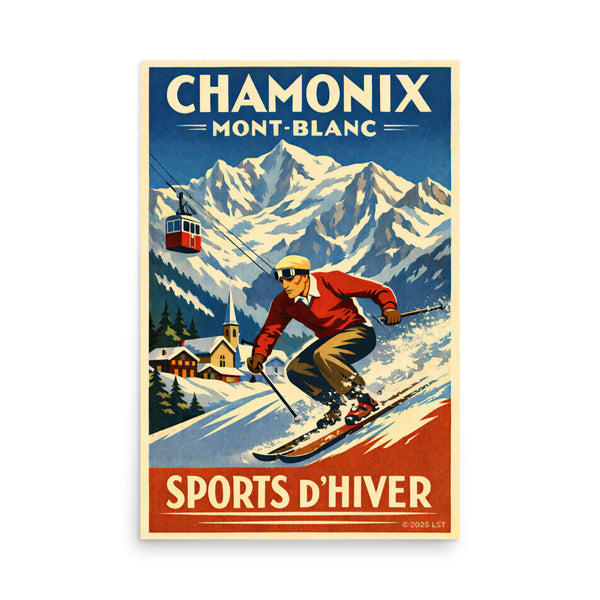
This poster embodies the Art Deco style prevalent in 1920s-1930s travel advertising, characterized by bold geometry, streamlined forms, and a sense of motion. The composition centers on a single skier descending against the dramatic Mont Blanc backdrop, using simplified lines and vibrant contrasts to convey speed and scale.
- Composition: Vertical poster format emphasizing scale—massif above, valley below, with a single skier driving the foreground movement. Dynamic angles and layered elements to suggest movement and altitude, ideal for wall display.
- Color / Palette: Warm reds, creams, and alpine blues typical of interwar travel posters; restrained for clarity and period feel. Cool blues and whites for snow and sky, accented with warm earth tones for depth and contrast.
- Typography: Bold, architectural Art Deco display type; "SPORTS D'HIVER" set for graphic weight and balance. Sans-serif fonts with geometric flair, mirroring interwar promotional aesthetics.
- Mood / Message: Alpine optimism—Chamonix as destination, culture, and technique, not just sport.
- Notable Details: "SPORTS D'HIVER" appears in all-capital display type consistent with vintage French poster practice; discreet © LST credit in the lower margin.
- Iconography: Features the Mont Blanc massif, skier in period attire, and "Sports d'Hiver" typography to evoke Chamonix's Olympic and mountaineering heritage, including subtle nods to early ski equipment silhouettes for historical accuracy.
This poster represents a place that defined alpine seriousness—where skiing became technical, cultural, and enduring. For collectors, it transcends mere decoration by encapsulating Chamonix's pivotal role in transforming skiing from a practical necessity into a global pursuit of excellence and adventure. The artwork honors the valley's mountaineering roots while highlighting its evolution through Olympic recognition and modernist aesthetics, making it an essential piece for those who appreciate the intersection of history and art.
Visually, the poster's Art Deco influences—bold lines, geometric forms, and a palette of icy blues contrasted with stark whites and subtle warms—evoke the era's optimism and precision. The depiction of a single skier in fluid motion against the imposing Mont Blanc massif captures the thrill of descent and the scale of the Alps, distinguishing it from more whimsical resort posters. Collectors should note the typography's elegant sans-serif style, which mirrors 1930s travel promotions, and the subtle iconography that nods to Sports d'Hiver campaigns, adding layers of authenticity.
What sets Chamonix posters apart from those of other alpine resorts is their grounding in real geographic and cultural authority. Unlike marketed destinations that prioritize leisure, Chamonix's legacy is built on challenge and innovation—from early guides to extreme skiing pioneers. This piece invites reflection on how places like Chamonix influenced equipment brands (e.g., Rossignol) and techniques, fostering a deeper connection for ski historians and enthusiasts. In a collection, it serves as a conversation starter, blending aesthetic appeal with educational value, and reminds us that true alpine art reflects the mountains' unyielding truth rather than romanticized ideals.
When you hang this poster, you're not filling wall space — you're placing a marker of knowledge, taste, and respect for ski history.
Beyond its artistic value, this poster commemorates Chamonix's foundational Olympic role in 1924 and its enduring connection to winter sport ever since, underscoring why it remains a mecca for skiers worldwide.
Frequently Asked Questions
Click the ▸ bars to expand.
Is this an official poster?
No. This is an original LongSkisTruck design inspired by 1930s Art Deco travel posters. It is not copied from any existing work, but rather created using period-correct design language, historical research, and museum-grade reproduction standards.
What makes this a "museum-quality" print?
Our posters are printed using the giclée method on archival, acid-free matte paper. This ensures that the colors remain vibrant and the paper does not yellow over time. Each poster is printed individually on demand to guarantee a fresh print and reduce waste by avoiding overstock storage damage. The poster is sold unframed, allowing you to choose a frame that best suits your decor.
Why is the 24×36" size priced higher?
Larger prints require higher-resolution source files, increased materials, and stricter quality control. The 24×36" format is intended as the primary collector size and represents the poster at its most impactful scale.
How is the poster shipped?
Each poster is shipped in a rigid mailer to prevent bending or creasing. Ships free within the US. Production takes 3–5 business days, and standard shipping within the US also takes 3–5 business days. Expect to receive your poster within 6–10 business days of ordering. You will receive a tracking number once your order has shipped.
What is your return policy?
We do not accept discretionary returns or exchanges. However, if your poster arrives damaged or there is a fulfillment error, please contact us within 7 days of receipt with photos of the issue, and we will arrange a replacement or refund as appropriate.
References
External Sources (Citations)
- Kandahar Ski Club — Official History
- Aiguille du Midi — Official Cable Car History (Chamonix)
- History of Chamonix — Official Site
- Chamonix 1924 — Olympics.com
- FIS History — Official International Ski Federation
- Montenvers & Mer de Glace — History and Access (Chamonix Official)
Internal Links (Site Navigation)
- Museum Poster Collection Posters / Prints
- Rossignol Brand Collection
- Dynamic Brand Collection
- About LongSkisTruck™
- All Collections
- Contact Us
- Vintage Ski Archive
More related posters and archive notes are available below — click the ▸ bars to expand.
Related Posters (Museum Poster Collection)
Archive & Media Notes
This poster design was created using period-correct Art Deco design principles, including geometric composition, restrained color palettes, and architectural typography typical of 1920s-1930s French travel posters. Historical research for this piece drew from primary sources on Chamonix's role in early alpine skiing, the 1924 Winter Olympics, and the development of ski racing technique.
Part of the LongSkisTruck Museum Poster Collection
Museum-quality prints. Historical authenticity. Exclusive designs.
Research, writing, and curation by LongSkisTruck™ Creative Studio.
Alpine Ski Posters & Vintage Skis | LongSkisTruck™ Ski Archive
Preserving one ski, one story at a time.


